
A 7-minute read on how the construction market changed after 2022 and why familiar marketing tactics stopped generating requests. Below are two tools that still work: AJTBD and Yandex PromoPages.

Author
Oleg Makarov
I have spent 10 years doing marketing in construction: facades, tiles, polymer concrete, insulation, and sandwich panels. The largest case is CeramicGroup: +300 million rubles in revenue driven by marketing. I now work with APEX, Zemtsov Group, and several other manufacturers.
This guide has no sales pitch at the end. No free audit, no diagnostic session, no “let's get on a call”. The goal is simple: understand what works now and what does not. Then decide for yourself whether you need a contractor and which kind.
What changed in the market after 2022
The construction market did not change slightly. The buying mechanics themselves changed.
- →Western brands did not fully disappear: they can still be bought through parallel import. But prices changed enough that buyers now calculate three times before choosing what used to be automatic.
- →Strong Russian manufacturers that were already known before 2022 stopped keeping up with demand. For hand-molded brick, the queue can now be a year or more.
- →Overall demand fell. High rates made mortgages expensive, private builds are frozen, and corporate projects cut budgets. There are fewer buyers, and competition for each one is harder.
- →Buyers stopped trusting ads at face value. Before ordering materials for a project, they search for reviews, call dealers, and ask colleagues.
- →The deal cycle stretched. What an architect could choose in two weeks now takes two to four months.
- →Trust in the brand became more important than price. Nobody wants to fail with a supplier on a 200-million-ruble project.
Why “just run ads” no longer works
The old scheme was simple: launch paid search, get requests, close deals. A request cost 1,500 rubles, and one deal could bring millions. The economics worked easily.
Now the same budget brings fewer requests. Requests convert into deals less often. Deals take longer. Marketing seems to be running, but less money reaches the account.
If this sounds familiar, the problem is not necessarily a bad contractor. And it is not that “advertising died”. The problem is that the “saw an ad → bought” path no longer works where deals are expensive and long. Construction deals are exactly that.
Instead of a short funnel — ad, request, sale — build a longer one: awareness, trust, choice, deal. It takes 3–6 months, but once the system is running it produces a steadier flow.
Two tools sit at the core of that system.
Tool 1: know the customer properly (AJTBD)
AJTBD describes a customer not through demographics, but through the job they are trying to get done.
It sounds complicated. In practice, it is simple.
The old way: “Our audience is architects and designers, men and women aged 30–55, Moscow and regions.” This description does not tell you what to say in an ad. Any phrase could fit, and any phrase can fail.
The AJTBD way: take a specific architect and describe what task your product helps them solve.
A chief architect at a bureau is delivering a comfort-class residential project near Moscow. Their key fear: in five years the facade fails and the property management company comes with claims. The job is to choose a material that will not fail and to have proof of reliability in hand.
From this description you immediately see:
- →what to write in ads: “20-year warranty”
- →which cases to show: projects that have stood for 7–10 years without issues
- →which objections to remove: certificates, standards, and reviews
The same product sells to different segments through different messages. A dealer has one job. An architect has another. A site manager has a third. One generic ad for everyone usually reaches no one.
Example: APEX, polymer concrete facade decor
Before AJTBD, APEX advertising sounded like this: “Polymer concrete decor. Architectural facade decor.” It was clear what was being sold, but not why anyone should buy it.
The research showed that people were not buying “polymer concrete”. They were buying solutions to three jobs:
- →“I want a beautiful facade without constant repairs”
- →“I do not want the decor to yellow and crack in a year”
- →“I want one supplier who takes responsibility for delivery and installation”
For private clients, we removed the term “polymer concrete” from the ad. The message became “facade decor that does not yellow or crack”. Request conversion grew.
Tool 2: Yandex PromoPages — advertising that warms demand
To understand PromoPages, separate advertising into two types.
Performance advertising catches a person when they are already ready to buy. They search for “buy porcelain stoneware for facade”, see your ad, click, and leave a request. It is fast and can have a low cost per lead, but it only works with people who have already decided.
Brand advertising works with people who have not decided yet. It introduces the product, explains why it is better, and stays in memory. A month later, when they choose a supplier, they remember you.
In construction, the winning format now is brand performance: advertising that both introduces the product and collects the attention of people who became interested.
PromoPages are one of the most practical tools in that category.
How it works
A person sees a teaser inside Yandex, clicks, and lands on an article about the product.
If the article is relevant, the person reads to the end. If the interest is real, they go to the website.
You pay only for completed reads. That changes the economics: you pay for attention, not empty clicks.
Why it works in construction
A long deal cycle means the customer needs to understand a lot before buying: material, characteristics, installation, warranty, past projects, and the manufacturer behind it.
A banner cannot hold all of this. A search ad cannot either. An article can.
A PromoPage gives the person 5–7 minutes of quiet reading. In that time they can understand the product, see cases, and build trust. When they choose a supplier two months later, they already know you.
Example: APEX
For APEX, we created a series of PromoPages for different segments:
- →An article on how to choose facade decor and not regret it in five years — for private clients building a house
- →An article with five questions to ask a facade decor contractor — for architects choosing a material for a project
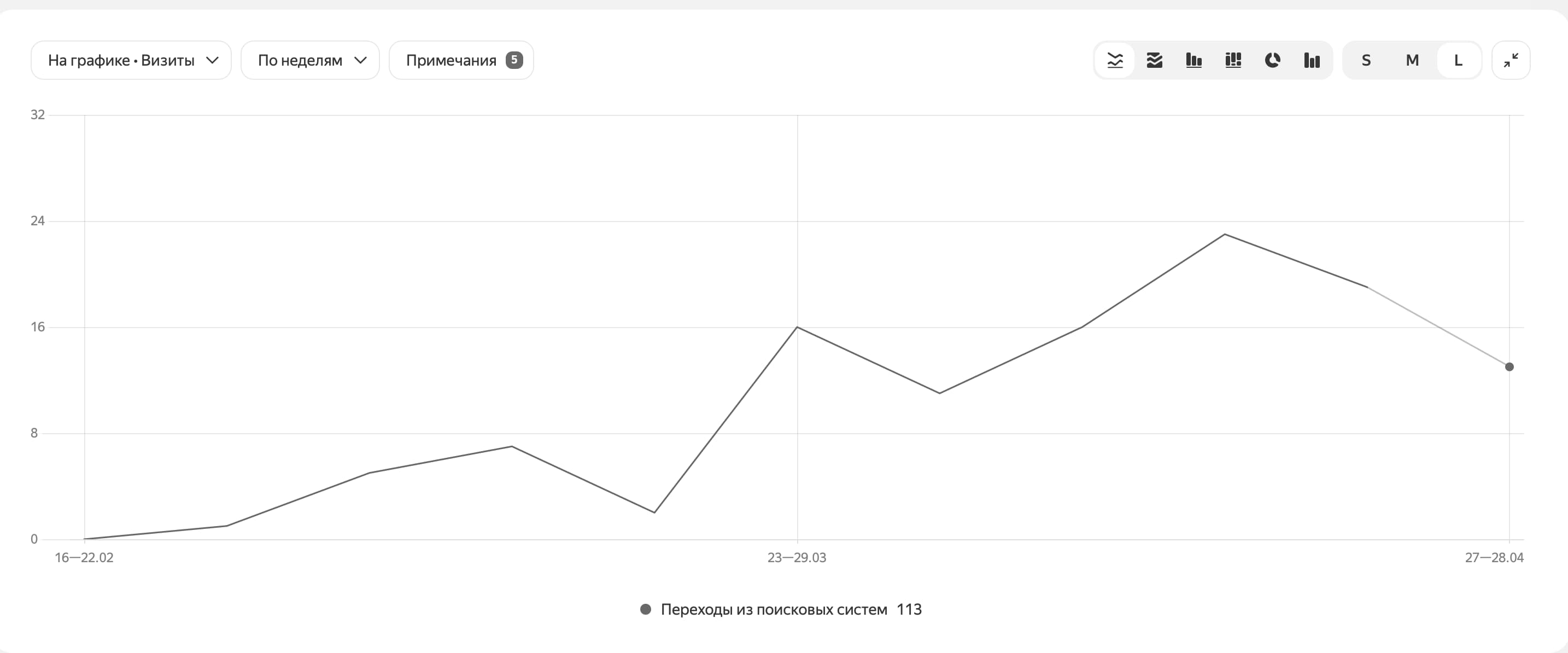
Each article works for its own segment. Nobody tries to sell head-on; we simply explain the subject properly. This approach has a useful side effect: the number of branded search queries grows.
How the system works together
The combination is straightforward:
- →AJTBD defines what to say and to whom: segments, jobs, and messages.
- →PromoPages provide the space to say it properly, without squeezing the message into a short banner.
- →Performance channels — paid search, SEO, retargeting — close the people who were warmed up by articles.
Without AJTBD, PromoPages are just another ad format that can waste budget. Without PromoPages, AJTBD stays theory with nowhere to unfold. Together they become a system.
Where to start yourself
If you want to try without a contractor, start with three steps.
Step 1. Talk to 5–10 customers. Not through a formal survey, but in a normal conversation. Ask: “Why did you choose us? What mattered most?” Write down the answers word for word. These answers contain your real segments and jobs.
Step 2. Rewrite your advertising messages. Take the main landing page or a search ad. Ask: which customer job does this message speak to? If there is no answer, rewrite it around the job you heard in step 1.
Step 3. Launch one PromoPage: one article about one product for one segment. Start with a modest budget, read the numbers after two weeks, then scale or change the approach.
If the first launch is imperfect, that is normal. No campaign starts perfectly. The important part is to begin and look at the numbers.
Bottom line
The construction market after 2022 works differently. Buyers are more careful, deal cycles are longer, and trust matters more than price.
Old tools — bare paid search and generic ads for everyone — bring fewer requests. This is not a contractor problem. It is a structural shift.
What works now:
- →AJTBD: describe customers through jobs, not age and gender
- →brand performance: warm demand through articles and PromoPages instead of selling head-on
- →the combination of these tools plus performance channels for closing warmed-up demand
It is a system that accelerates over 3–6 months and then gives a steadier flow.
Telegram
Subscribe to the Telegram channel
If this article was useful, subscribe to my Telegram channel about marketing in construction.
Open @betonmarketing